AI, Drones and the Future of Security: What Security Leaders Need To Prepare For
Deborah Evans BSc MSc
The evolution of Artificial Intelligence (AI) in drones, robotics and Unmanned Systems (UxS) is transforming the security landscape at an unprecedented pace. Once viewed as niche or future technologies, UxS are now operational across military, law enforcement and commercial security environments; and their capabilities are expanding faster than many organisations are prepared for.
In a recent episode of ASIAL’s Security Insider podcast, hosted by John Bigelow, Deborah Evans from Edith Cowan University explored the current state of UxS including Unmanned Aerial Vehicles (UAVs) and other platforms, separating real-world capability from hype and outlining what security leaders should be taking into account to prepare for the future security environment.
UxS today extend far beyond consumer drones. They include unmanned aerial, ground, surface and underwater vehicles, ranging in size from micro and nano systems to large platforms comparable to manned aircraft. A major recent driver of innovation has been the conflict between Russia and Ukraine, where UxS have moved to the forefront of combat operations. This has accelerated development globally, drawing in commercial manufacturers, startups and technology suppliers at scale.
Despite public concern, most systems in operation today are remotely operated or semi-autonomous as opposed to fully autonomous. They rely on machine autonomy; rule-based systems which are pre-programmed to perform specific tasks such as waypoint navigation, obstacle avoidance and automated return-to-base functions. When confronted with unknown scenarios or events which have not been pre-programmed or anticipated, these systems require human intervention. According to Evans, true intelligent autonomy, where systems can independently modify decision pathways and understand higher-level intent, does not yet exist and is unlikely to emerge until Artificial General Intelligence (AGI) and quantum computing become established more broadly.
While fully autonomous weapons may not yet be a reality, Evans warns that security concerns may be justified. As machine learning systems develop in complexity, their decision-making processes become less transparent, raising challenges around predictability, accountability and control. These risks are amplified by global AI competition, with China and the United States leading development. China’s strategic approach, combining early deployment, real-world refinement and strong military-civil fusion, positions it as a significant force in the future of autonomous systems.
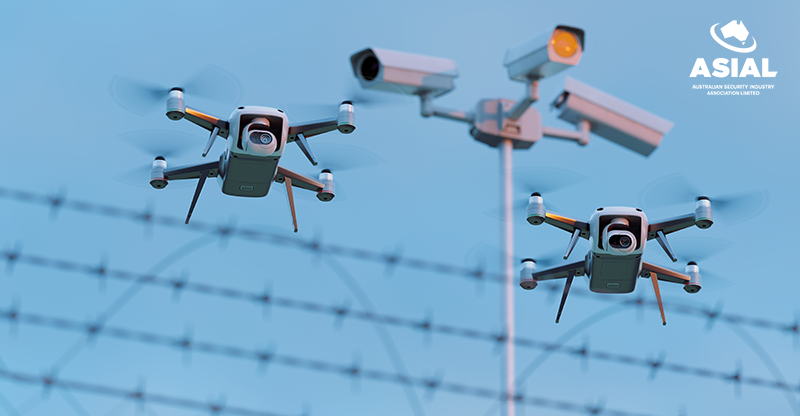
For the security sector, the implications are significant. Many protective security environments, including stadiums, ports and critical infrastructure, were designed for two-dimensional, ground-based threats. Today’s risks are increasingly three-dimensional, multi-domain and mobile. While counter-UAS technologies exist, and may include or combine different types of technologies such as radar, radio frequency (RF), optical and acoustic sensors, each has limitations, particularly against small, low-cost or swarming systems. Kinetic countermeasures are often unsuitable in urban settings, and even non-kinetic responses carry safety and regulatory challenges.
Evans argues that technology alone will not mitigate threats from emerging technologies. Security organisations must adopt a holistic approach that integrates preparedness, deterrence, detection, delay and response methodologies, in addition to building design and regulation. Even simple considerations, such as spatial planning and exposure to elevated vantage points, can significantly reduce risk when viewed through a modern threat lens.
The key message for security leaders is clear: autonomous and semi-autonomous systems are no longer a future concern, and we are likely to see threat actors increasingly adopt a range of UxS and platforms to perpetrate criminal and terrorist activities. Planning must begin now to ensure security strategies evolve in alignment with emerging technologies, rather than responding with ad-hoc measures to three-dimensional threats as they emerge.
Deborah Evans BSc MSc is the Director of a private research consultancy company and a PhD Candidate at Edith Cowan University, Western Australia.
To listen to the recent ASIAL Security Inside podcast in full, click here